Follow Now...!

Winter Palace of Bogd Khan


Winter Palace of Bogd Khan
Built between 1893 and 1903, the Winter Palace of Bogd Khan was the home of the Mongolia’s last king Javzun Damba Khutagt VIII. This complex of temples and houses contains a number of Buddhist artworks and the private collection of the Bogd Khan, composed of gifts from rulers and kings from all over the world. The artworks displayed here were made by the top Mongolian, Tibetan and Chinese master-sculptors of the 18th and 19th centuries and represent the gods of the Buddhist pantheon.

Gobi Desert


The Gobi desert, one of the world’s great deserts, covers much of the southern part of Mongolia. It is one of the major tourist destinations in Mongolia. It is a huge arid region in the Asian continent. The desert includes portions of South Mongolia and northern and northwestern China. Gobi desert plateaus are bordered by the Tibetan plateau and Hexi Corridor to the Southwest, Altai Mountains and the prairielands and lowlands of Mongolia to the north, and by the North China Plain to the southeast. The desert encompasses several discrete environmental and geographical parts on the basis of variances in weather and landscape. The Gobi Desert is the fifth largest desert in the world.

Gun-Galuut


Gun-Galuut
Amazingly, Gun-Galuut is the state combined from diversity of ecosystem although it owns comparatively small area. The harmonized complex of high mountains, steppes, rivers, lakes and wetlands as well are kept enough as its original condition. Whoever visiting enjoys to see Gun-Galuut vast steppe seems to meet the sky, the imposing mountains Baits and Berkh, a home land of rare creatures, Ikh-Gun and Ayaga lakes, a paradise of birds, Kherlen, the longest river of Mongolia and Tsengiin Burd wetland, in where water and wetland birds lay their eggs.

Gorkhi Terelj National Park


Gorkhi-Terelj National Park
The Park is situated at 80Km. north east of Ulaan Baatar, and is a very popular area both with the locals on a week end and with foreign tourists. It took us nearly two hours to drive from the capital as the roads were pretty bad. The park lies at 1600 metres high and offers great opportunities for hiking, horse-riding, rafting and rock climbing. The parks is over 1.2 million acres large. The landscape is looking a little bit like the alps. It is a national park which started to developed in the 1960′s and officially was classified as a National Park in 1994. It is almost uninhabited by humans, only by a few nomads and farmers. Inside the park, there are ranges of protected animals such as birds (250 species), moose, and bears. As it become developed for tourism, some of the Ger camps have concrete car parks and electricity. Camps are not at the same place depending of the season, there are summer camps, and winter camps which are open mostly all year long.

Hustai National Park


Hustai National Park Tour
Hustai National Park is the site of a unique re-introduction scheme of Przewalskii’s horse (Equus przewalskii),  called “takhi” by Mongolians. It became extinct in the wild in 1969 and, since 1992, have been successfully re-introduced to Hustai from zoos around the world. This has been an international effort monitored by The Foundation for the Przewalskii Horse, based in the Netherlands and MACNE (Mongolian Association for Conservation of Nature and the Environment). The national park is rolling steppe mountains with rather large patches of birch and aspen forests. There are also visible remains of neolithic graves. In addition, red deer (Cervus elaphus) and wolf (Canis lupus) have increased quite a bit during the last few years, as well as Mongolian gazelle. Species present in Hustai but usually not seen include lynx, argali sheep and roe deer.

Erdene Zuu Monastery


Erdene Zuu Monastery
In 1586 when the Mongolian Khan Abtaisai returned home from his long pilgrimage to Tibet, he founded the first Buddhist monastery for it?s beauty it was named Erdene Zuu or Hundred Treasures. Erdene zuu was the first Buddhist monastery in Mongolia It is surrounded by a monumental wall with 108 stupas measuring 400×400 meters. Each of the four sites of the wall has a tower gat. In 1792 there were 62 temples. 500 buildings with about 1000 lamas inside the surrounded wall. It houses considerable historical and cultural values statues of deities, ritual masks and costumes, canvases on religious motifs, samples of mural and ceiling painting, articles, made by crafts men. Erdene-Zuu’s temples were destroyed by the anti religious campaign of Stalin of the 1930s and an unknown number of monks killed. The monastery remained closed until 1965 when it was permitted to reopen as a museum.


Kharkhorum resort
Kharkhorum is a destination not to be missed for those visiting Mongolia. In the 13th century it was the capital of the Mongolian Empire. This town is close to Erdene Zuu monastery, built in 1586 using the stones from the ruins of Kharakhorum. It was the first Buddhist center in Mongolia and it housed 10,000 lamas(monkis) in 62 temples. In 1930’s it was badly damaged by the Stalinist purges and only since 1990 has become an active monastery again. Two Turtles Carved from rock marked the boundaries of the complex. Nearby is Shanhiin Hiid(monastery) and Orkhon waterfall. Because of its proximity to Ulaanbaatar, Erdene Zuu and Kharakhorum can easily be a part any trip.

Achit Lake

Achit Lake
It is one of the largest lakes of Mongolia, covering 311 square kilometers. Length of lake is 30km width is 16km. It is between Kharkhiraa Uul and Turgen Uul, at 1,464 meters above sea level. Achit lake is irrigated from 10500sq.km square and fed by Altangadas and Bukh murun rivers therefore feed the Khovd river. The island of Devel in the Usan Khooloi River has been protected the state protection. 

Ugii lake


Ugii Lake
Located in 1337m above sea level, Ogii Nuur soum, Arkhangai province. It engages 25sq.km of area, length is 7km, width is 5km and at the deepest part it’s 15m. The lake abounds in various types of fish and birds, which creates an incredible natural beauty. More than 14 types of fish and more than 150 types of bird inhabit there. You can visit to this lake easily; on a day trip from Kharkhorin (Erdenezuu monastery). By the road you can visit to Khushuu tsaidam monument, memorial of ancient Turkic emperor Bilge khan, only 45km from Kharkhorin on asphalt road.

Khar us Lake


Khar us Lake
Mongolia’s second largest fresh watered lake Khar Us Lake is located at the 1152m above sea level, Khovd province, in western Mongolia in the Great Lakes Depression. It’s area value is1852 sq.km included more than 10 small and big islands because of tectonics. The biggest island is Agbash which divide lake into south and north parts and divided parts connected by canal named “Lun Yum”, 20km long. About lake size, length is 72km, width is 26 km but it’s depthless, only 4.5m at the deepest part.

Terkhiin tsagaan lake


Khorgiin Togoo volcano and Terkhiin tsagaan lake
Located in Tariat soum, Arkhangai province. About origin of fresh watered Terkhiin Tsagaan Lake, flowing of north and south Terkh Rivers locked by lava flow from a volcanic eruption. The length of lake is 16 km; width is 6 km, 20m deep, 2060 m above sea level and occupies 61 sq.km area. The biggest river which is one of the 10 rivers, flow into lake is Terkh river. Also only one river flows from the lake is Suman River. Suman means “Arrow” because this river flows through the lake like an arrow. There is a small island at the middle of the lake, birds make their nest and lay eggs. There is a interesting story about Terkhiin Tsagaan Lake.

An ancient time, a mother and son were living this land and they carried their drink water from small fountain from the deep of ground. After they take some water they have to bung it. But one day son went to this fountain to take drink water but he forgot to bung it after take and he slept next to the fountain. Later some minutes this some area covered by huge water and son’s mother worried about his son and she take top of mountain named “Uran mandal”, bung the fountain. Since that time this lake is exist here. The top of “Uran mandal” mountain is Small Island that mentioned above.

Khorgiin Togoo volcano, located on the bank of Terkhiin Tsagaan Lake, 180 km away from center of Arkhangai province. The volcano erupted to encompass huge of sq.km area 8 thousand years ago. Around the volcano there many cauldron shaped places to hide so Khorgiin togoo name is connected to these places. Also there are some interesting places such as ice cave, “Shar nokhoin tam” (hell of yellow dog) and “Cave of a person” around the volcano. 50 sq.km of this area preserved in 1965.

Uvs lake


Uvs Lake
Uvs Nuur /Lake/- the largest lake in Mongolia. It is 743 meters above sea level, 80kms wide and 80 km long, covering 3.350 square kilometers with clear but brackish water a land-locked Inland Sea. The range of ecological zones in the relatively small area of the Uvs Nuur Lake Basin in Uvs Province is matched by few places in the world. Except of Mongolia’s highest peaks Altai tavan bogd, this range is the coldest part of the country, in 1974 a temperature of -57 C was recorded. Summer temperatures typically climb to over +40 C, and these extremes are one reason why the lake was chosen as one of ten locations globally to be studied for climate change by the international Geo-Biosphere Program.

The Uvs Nuur region encompasses 712,545 hectares of land. Established in 1993, it consists of four separate areas – Uvs Lake, Turgen Mountain, Tsagaan Shuvuut and Altan Els. Between them, the protected area contains everything from desert sand dunes to snowfields, and marsh to mountain forest. Uvs Nuur is five times saltier than the ocean, and devoid of edible fish, but this doesn’t mean the lake is dead. The Nariin, Sagil, Borshoo and Khundlen rivers enter, but none drains out. It is a magnet for birds; over 220 species are recorded, including Osprey, White-tailed Eagle and Black Stork. There are Swan Goose, Bar-headed Goose and Eurasian Spoonbill. Over 100 pairs of Spoonbill nest in the vicinity, also Great White Heron. Whooper Swan, Great Black-headed Gull, White-headed Gull and Black Stork.

White lake


White Lake
About 50km west of Khovsgol Nuur, in Renchinlkhumbe sum (district), is a large depression called Darkhadyn Khotgor, often referred to as Tsagaan Nuur, after the main village in the area. The Darkhadyn Depression is roughly the same size as Khovsgol Lake and was indeed originally formed as a glacial lake.The difficulty in reaching the region ensures that the unique Tsaatan people who inhabit the valleys are able to continue their traditional lifestyle - but tourism is slowly making an impact.

Darkhadyn khotgor is one of Mongolia's strongest centers of shamanism. This is one of the best-watered regions in Mongolia: the aimag has about 300 lakes and 200 of them are in this area. The lakes are a vital part of Mongolia's very limited commercial fishing industry - white carp and trout are packed in salt and flown out to Ulaanbaator to be served in the fancier hotels. Salmon and huge taimen can also be found in the region. One definite drawback to visiting the region is the insects that invade the area.

Orkhon waterfall


Orkhon waterfall
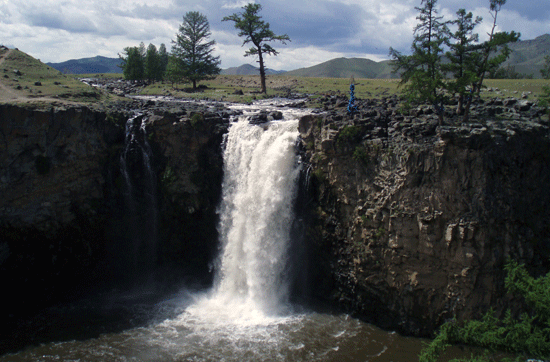
Generally, Orkhon River and its water basin valley are considered the cradle land of steppe nomads. Apart from the springs at Khujirt, the main attraction in the area is the Orkhon waterfall. The Orkhon waterfall is situated in the historically significant Orkhon Valley; Orkhon River flows 1120km to the North before it joins the Selenge River. Also this waterfall is called Ulaan Tsutgalan, formed by volcanic eruptions about 20.000 years ago, the waterfall cascades from a height of 20m. It is scenic, tranquil spot and surrounding nature is undisturbed, as such there are opportunities for good walking and riding in the area. The Orkhon river is pristine drink water river and also it is teemed with a lot species fish such as taimen, lenok and so on. These days yak breeder nomads are living in near the waterfall

8 lake

Naiman nuur - 8 lakes
Naiman Nuur – Naiman Lake was created by volcanic eruptions centuries ago, covers 11,500 hectares around the lake located in Ovorkhangai Province to the southwest of the Khangai Mountain Range. Naiman Nuur with its exceptional configuration is surrounded by the beautiful nature of the middle part of the Khangai Mountain. These lakes with fresh water and interconnected by ground water channels such as Shireet, Khaliut, Bugat, Khaya, Khuis, Onon, Doroo, Bayan-Uul are called Khuisyn Naiman Nuur. These lakes located in 500m to 3km to each other. It was placed under state protection in 1992.

Khuvsgul Lake


   Khuvsgul Lake
Khuvgul Lake, freshest and deepest lake in Central Asia, is positioned in a North South direction with an oval shape. Its length is 133.4 km from north to south while widest is 39.5 km from west to east. This lake has a volume of 380 km3 and it is second in Asia and 14th largest in the world. Khuvsgul Lake contains 93.6 % of total surface fresh water of Mongolia and 1% of world fresh water. Khuvsgul Lake is surrounded by beautiful high mountains of the Khoridol Saridag and Bayan Mountain Ranges, along the west shore. Many mountain rivers flow into this lake including 17 rivers flowing during the whole year. Flat-topped mountains with sloping mountainsides, covered by forests, lie on the east shore of the lake and those mountains are sources of 29 rivers flowing into Khuvsgul Lake.

The Munkh Saridag Mountain Range, the highest mountains in Khuvsgul province, are along the north shore of this lake. South part of Khuvsgul Lake becomes narrow and the Eg River starts out here. Drainage basin of the lake is 5,300 sq km that holds 46 rivers and streams. 69% of South side of Khuvsgul Lake is deeper than 100 m. The lake water is coldest in Mongolia, with +18 Celsius of water surface in summer, because of its deepness. It starts to freeze in September but completely covered by 1.0-1.5 m thick ice in November while it starts to melt in May but sometimes it keeps its ice until beginning of July. Water visibility is up to 22.9 m in the middle, but it is 14.3 m near the shore.

There are 4 islands namely Modon Khui, Khadan Khui, Dalain Khui and Baga Khui. From these, the largest one is Dalain Khui Island with a 5.8 sq km area, 70 km from north shore. Nine species of fish inhabit Khuvsgul including omul, herring, lenok, grayling, perch and roach. This area has been protected since 1992 as a National Park. The lake is still being used for transportation. Russian merchants started using boats for transportation in 1913

Khyargas Lake and Khan Khukhii mountain

Khyargas Lake and Khan Khukhii mountain 
The Khan Khukhii mountain range is located in Zuunkhangai, Undurkhangai and Tsagaan Khairkhan sums of Uvs province, was taken under protection in 2000 with an area of 2206 square kilometers. The Khyargas Lake was also taken under protection in 2000 with an area of 3328 square kilometers. Khan Khukhii mountain range is located deep in the mountain valleys and is a demarcation of Uvs and Khyargas lake basins. The area plays an important role in maintaining ecological balance by limiting the process of desert-steppe region increase. The peak of Duulga reaches 2.928 meters above sea level. Many picturesque mountains are here, such as Bushtag, and Altanburgas, as well as Khan Khukhii Mountain. Khyargas and Airag lakes provide a home to numerous globally endangered bird species that are listed in the Red Book of Mongolia.

Bayan lake


      Bayan Lake
 The salt lake, among the Bor Khyariin Els sand dune, is in the remote western part of Zavkhan aimag and difficult to reach. The scenery is fascinating and locals claim there is good fishing.